.png)
Search this site
426 results found with an empty search
- 2013SPp2q9 – Pressure and Moment
Solutions: (a) (i) A bigger force than F can be obtained due to the lever system and hydraulic system . Lever system: Applying principle of moments, the anticlockwise moment by the F is equal to the clockwise moment by the force on piston A (note that the handle is pushing the piston down, but the piston A is pushing on the handle upwards – action = reaction). As the perpendicular distance from F to the pivot is greater than the perpendicular distance of the force by piston to the pivot, the force on the piston A is greater than F at handle. Hydraulic system: As the pressure transmitted in the liquid is the same, pressure at piston A = pressure at piston B. As P = F/A and area of piston A is smaller than area of piston B, a larger force is obtained in piston B. Hence these two systems allow the force on piston B to be greater than F at the handle. (a) (ii) Both liquid and gas molecules are in a continuously random motion. But in liquid, the molecules are closely packed together and able to slide around one another. There is very little empty space between the molecules hence liquid is not compressible. Gas molecules are far apart from one another, hence gas can be easily compressed. (b) P = F/A = 12000 / 0.060 = 200 000 Pa (c) Velocity is the vector quantity while speed is a scalar. As the car goes round the bend, the direction of the car changes. Hence velocity is changing even though speed is constant. Likewise, as the velocity is changing, the car is considered to have an acceleration )and the acceleration is towards the centre of the circle of the bend)
- Using barometer to estimate height of mountain
At sea-level, the barometer which Pie is holding reads 760 mm of Hg. When he is at the top of Mount Pie, the same barometer reads 230 mm of Hg. Given take the density of mercury to be 13.6 g cm-3 and the density of air, 1.23 x 10⁻³ g cm-3. Estimate the height of the mountain? Solutions: 5860 m
- Pressure – Height of ethanol in the column
Answer: Option D
- 2 pistons of different pressure joined together - P1V1 = P2V2
Solution: Option C
- Barometer with a layer of water – Find height of mercury H
Answer: Option B
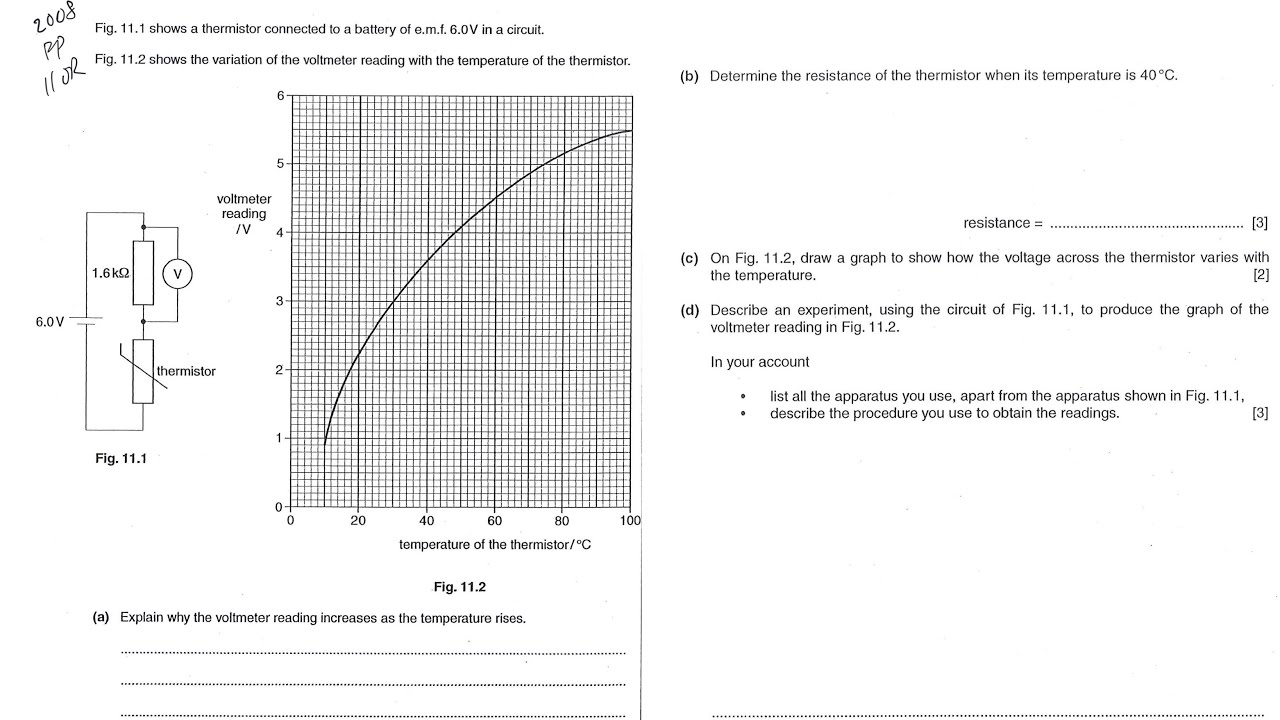
- PP2008Q11OR Thermistor in series with fixed resistor, explanation on pd and graph
As both the fixed resistor and the thermistor are connected in series, the sum of potential difference across them will be equal to the emf of 6.0 V.
- Where is the focal point of lens L1 and L2?
Answer: Option A Refer to the diagram (below left) which many are familiar. When parallel rays of light which are parallel to the principal axis enter the lens, the rays bend (refraction), come closer and converge to a point on the principal axis called focal point (F) . The distance from the optical centre (C) to the focal point (F) is the focal length (f) . But what if the parallel rays of light entering the lens are not parallel to the principal axis but at an angle as shown on the diagram (below right)? As you can see, the rays refracted and converge to a point P which is along the focal plane (imaginary vertical line through F and is perpendicular to the principal axis). This is similar to L1 in the question. (Refer to the first section of the video simulation below to reinforce your concept) How about L2 in the question? Light is reversible so you can also treat the light rays entering from the right of the lens L2. The parallel rays of light in L2 are at an angle but there is no ray through the optical centre C. Refer to the video below, as you can see, the parallel rays of light will likewise refract and converge to a point, which is along the focal plane too. Hence the focal point of both lenses L1 and L2 is at F2. So the answer is Option A.
- Lens, screen and mirror – what kind of image formed on screen
Answer: Option C
- Total Internal Reflection (TIR) example 01
Solutions: a) Refraction b) 48.6o c) c = 41.8o e) 70o d) Total internal reflection has occured, as the angle of incidence is greater than critical angle and the light is traveling from a denser medium (glass) towards a less dense medium (air) Click on the video tutorial for explanation and working for part (a) and (b). Click on the video tutorial for explanation and working for part (c) to (e).
- Total Internal Reflection (TIR) example 02
Solutions: a) 38.8o b) 41.8o c) 51.2o . The ray does not emerge as total internal reflection has occurred. The angle of incidence is greater than critical angle and the light is traveling from a denser towards a less dense medium. Click here to view the video tutorial for working and explanation for (a) and (b). Click here to view the video tutorial for working and explanation for (c) and (d).
- Boy on spring board - Moments Question using Simultaneous Equations
Note: Non-uniform plank means the CG of the plank is not at its centre a) Find the weight of the boy. b) How far is the centre of gravity of the plank from point A? Solutions: a) 300 N and b) 6.67 m Click on the video tutorial if you can’t derive the 2 equations.