

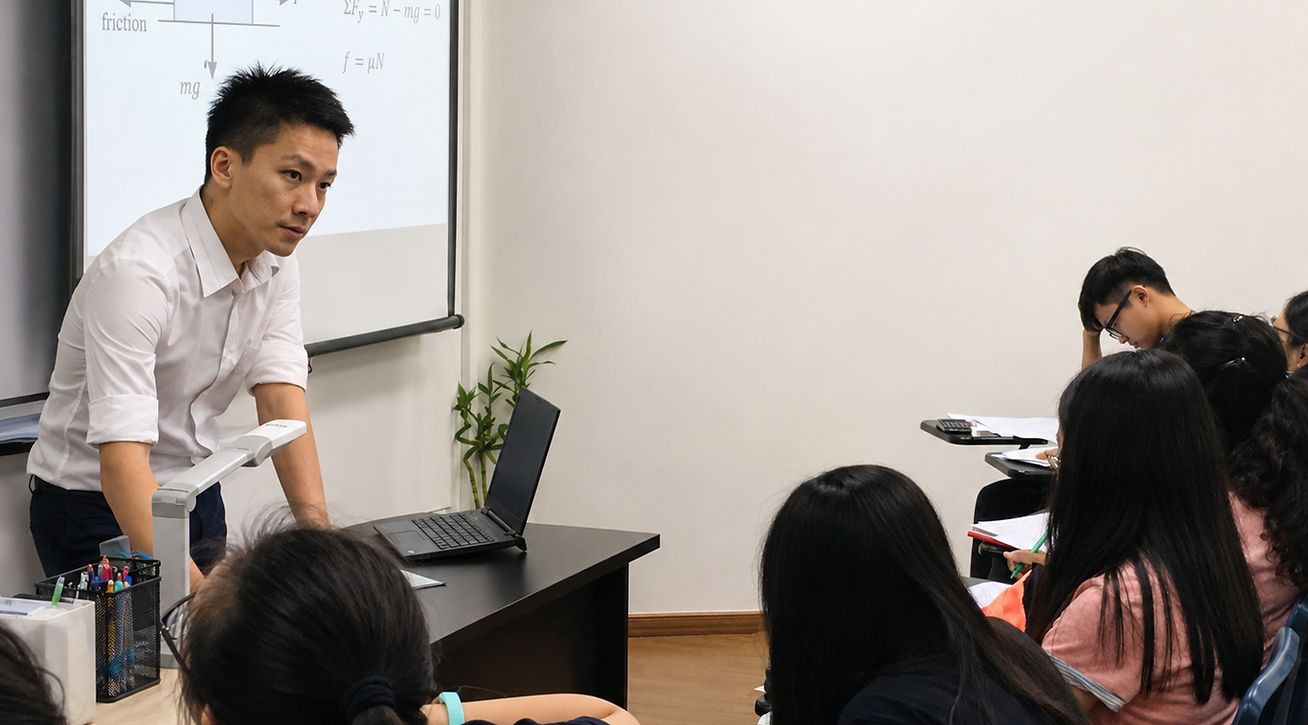
Secondary Pure Physics Tuition in Singapore for O-Level & IP Students
Physics requires students to connect concepts, diagrams, formulas, practical evidence and precise scientific explanations. Our programme helps Sec 3 and Sec 4 students strengthen these links systematically while preparing for school and national examinations.
EX-MOE PHYSICS EDUCATORS · O-LEVEL & IP SUPPORT ·
ON-SITE & ONLINE OPTIONS · IN-HOUSE NOTES & WORKSHEETS
Why Capable Students Still Lose Marks in O-Level / IP Physics
A capable student may understand a topic during a lesson yet still underperform in Physics. The challenge is often the level of decision-making required: identifying what the question is testing, applying the right approach, linking several ideas and sustaining accurate working through a multi-step solution.
Formula Matching without Understanding
Students often attempt to plug numbers into any formula that seems to fit variables, without understanding the underlying physical constraints of the situation.
Missing Units/ Significant Figures
Routine loss of marks through inconsistent use of SI units and failing to round final answers to the appropriate precision required by the question.
Incomplete Explanation Answers
Losing marks by providing fragmented observations instead of a logical chain of reasoning that links the concept to the observation clearly.
Weak Practical Evaluation
Difficulty in identifying experimental errors or proposing scientific improvements beyond generic 'human error' statements in practical assessments.
Misreading Diagram or Graphs
Misinterpreting scale, origin shifts, or the specific physical meaning of gradients and areas under various Physics graphs.
Mistaking Conceptual Familiarity for Application Ability
Relying on passive reading of notes rather than engaging in the active application required for multi-step problem solving.
Our goal is to help students turn sound conceptual understanding into accurate, well-explained and examination-ready answers.
What Our Students Will Learn to Do Confidently
Our programme focus is on developing independent Physics learners who possess the technical skills required to bridge the gap between initial concept exposure and exam success.
Understand the physical meaning behind formulas
Apply familiar principles to unfamiliar situations
Construct precise explanation answers
Recognise the concept tested
Interpret diagrams, graphs and experimental data
Check calculations, units, significant figures and final answers
Taught by Experienced Ex-MOE Physics Specialists
Students learn from educators with deep classroom, curriculum and assessment experience across O-Level and IP Physics.


What Happens During a Typical Physics Lesson?
Each lesson combines clear concept development, worked examples, guided practice and focused feedback so students know what to improve and how to apply it independently.
01
Review Prior Knowledge
Begin with focused recall of prerequisite ideas and a quick check of what students already understand.
02
Explain the New Concept
Build the new idea through clear physical models, precise definitions and the meaning behind relevant formulas.
03
Connect Ideas to Diagrams and Applications
Link abstract ideas to diagrams, graphs, experiments and everyday situations so the concept becomes usable.
04
Model Worked Examples
Demonstrate how to analyse the question, choose an efficient method and present complete working step by step.
05
Guided Practice and Feedback
Move from supported questions to independent practice while the teacher identifies misconceptions and corrects errors.
06
Consolidate Examination Techniques
Finish with examination techniques, scientific phrasing, units, significant figures and a clear next step for revision.
Topics Covered Across the Curriculum
Measurement and Mechanics
Units and measurement; kinematics; dynamics; mass, weight and density; moments; pressure.
Energy and Thermal Physics
Work, energy and power; kinetic model; transfer of thermal energy; thermal properties and temperature measurement.
Waves
General wave properties; light; electromagnetic spectrum; sound.
Electricity
Static electricity; current; D.C. circuits; practical electricity.
Magnetism, Induction and Radioactivity
Magnetism; electromagnetism; electromagnetic induction; atomic structure and radioactivity.
O-Level and IP Physics Learning Materials &
Exam Preparation
Students use curated study notes and worksheets designed to simplify complex topics, with lesson-video recordings available for revision and catch-up. Practice develops conceptual application, multi-step reasoning and precise explanation structures, together with units, significant figures, practical and data-handling skills.


Support That Continues Beyond the Lesson
Students receive practical support to keep learning on track when questions arise or a lesson is missed.
01
Concept & Principle Diagnosis
Tutors help students identify the Physics misconception behind an error and determine which principle should be applied before choosing equations or starting calculations.
02
Multi-Concept & Problem-Solving Support
Students receive guidance on connecting ideas across H2 Physics topics, setting up unfamiliar problems and checking signs, directions, units and vector relationships.
03
Data, Explanation & Practical Reasoning
Feedback focuses on interpreting graphs and experimental data, structuring clear Physics explanations and strengthening the reasoning needed for practical and data-based questions.
04
Clarification, Revision & Catch-Up
Students can use the existing one-to-one WhatsApp academic support for Physics questions, while lesson recordings and structured materials help them revisit difficult concepts and missed lessons.
For centre-wide support that applies across all subjects, including lesson arrangements and broader learning support, see our Student Support System on the Home page.
How Our Students Have Grown in Physics
Every student begins with different strengths and challenges. These experiences from Secondary and IP students show how clear explanations, structured practice, detailed feedback and consistent guidance can help students develop stronger understanding, confidence and examination skills.
On Conceptual Understanding & Progress
Shi Han,
Nan Chiau High School
Mr John Lee helped me progress from a passing grade to an A1. His engaging lessons helped me understand Physics concepts much more clearly.
On Answering Skills & Feedback
Jing Hsuen,
Tanjong Katong Girls’ School
Mr John Lee guided us through Physics concepts using clear summaries and gave useful feedback on how to develop and structure our answers. My understanding improved greatly, and this was reflected in my results.
On Calculation & Explanation Accuracy
Ong Yiting,
Nan Hua High School
I can now answer calculation and explanation questions more accurately and understand Physics concepts more clearly. Mr Khoo also provides individual help and time to clarify doubts.
On Learning Materials & Exam Practice
Yong Khee Hou,
Hwa Chong Institution
The notes helped me understand topics such as Electromagnetic Induction, while the worksheets strengthened my answering techniques and exposed me to more question types and challenging examination-style questions.
Edited extracts from published SG Physics student testimonials.

O Level & IP Physics Class Options
-
O Level & IP Physics lessons are 2 hours long.
-
The fee is $90+gst per S4 lesson, and $85+gst per S3 lesson.
-
Students may attend on-site or online, with learning-centre options at Bishan, Bukit Timah, Jurong East and Marine Parade.
-
Lesson recordings provide additional catch-up and revision support.
Frequently Asked Questions
About O Level/ IP Physics
Is this Physics tuition suitable for both O-Level and IP students?
The centre's Secondary Physics programme serves O-Level and IP students. Because school pacing can differ, students should choose a class that best matches their level and current syllabus coverage.
What does O-Level Physics tuition focus on?
Our programme build concept mastery, calculation accuracy, graph and data interpretation. We will hone students' scientific explanations, and increase their exposure to varied exam-style questions across the syllabus.
Are the notes aligned with the school syllabus?
Yes, our notes and worksheets are constantly updated in accordance with the school curriculum, and our teachers keep abreast of syllabus changes.
Can students bring school Physics questions to clarify?
Yes. Students may bring school assignments to clarify doubts during tuition.
Can a student join after the school year has started?
Yes, subject to class availability. Students joining later should tell the centre which topics they have covered so the teacher can advise on catch-up needs.
Is O-Level Physics mainly about using formulas?
No. Students must understand the physical ideas behind formulas, interpret information, apply to the scenario, and communicate explanations clearly. Formula substitution alone is not enough for many structured and unfamiliar questions.
How should students revise Physics definitions?
Learn the meaning rather than only the wording. Students should be able to recognise when a definition applies and use precise scientific terms when explaining a new situation.
Why do students struggle when they start Upper Secondary Physics?
Physics requires students to connect concepts, diagrams, equations and explanations. Many questions test application rather than direct recall, so students need both conceptual understanding and disciplined working.
Who teaches Secondary Physics?
Our Secondary Physics specialists includes Mr Wynn Khoo, Mr John Lee, Mr Paul Cheong and Ms Dawn Tan. You may check the teachers page for current profiles.
Will students practise structured and calculation questions?
The centre's materials and teaching approach include varied practice questions. Students should expect to work on both conceptual explanations and quantitative problem solving rather than only memorise formulas.
Is Secondary Physics available online?
On-site and online options are offered. Check the latest schedule for the available Secondary Physics classes and modes.
What happens if my child misses a lesson?
Students should inform the centre early. Depending on availability, they may attend another suitable class, join an online lesson or use a lesson recording to catch up.
How can students improve Physics calculation questions?
Start by identifying the quantity required and the relevant principle, write the equation before substituting values, keep units consistent and check whether the final magnitude is sensible.
Does O-Level Physics include practical skills?
Yes. Practical and experimental skills form part of the O-Level Physics syllabus and assessment. Students should refer to the current SEAB syllabus for the exact requirements for their examination year.
