

Why Capable Students Still Lose Marks in Lower Seconday Math
The jump from PSLE to Secondary School Math is one of the sharpest academic transitions a student faces. Relying on primary school memorisation and pattern recognition no longer works.
Primary School Math
-
Concrete numbers and models
-
Pattern recognition and drills
-
Simple, direct problem sums
Lower Secondary Math
-
Abstract algebra & symbolic variables
-
Multi-step logical reasoning and proofs
-
Complex, real-world applications
The "Algebraic Gap"
Struggling with negative numbers, indices, and abstract variables.
Rote Memorisation
Getting stuck when exam questions tweak familiar formats slightly.
Careless Errors & Poor Layout
Losing method marks due to disorganized steps and sign errors.
Math Anxiety & Sudden Grade Drops
Losing confidence after their Weighted Assessments
Our programme is built specifically to turn this transition into a trajectory for academic success.
What Our Students Will Learn to Do Confidently
Rather than relying on short-term memorisation, our programme equips students with the exact skills needed to master Lower Secondary Mathematics:
Tackle Abstract Algebra with Ease
Transition seamlessly from primary arithmetic to abstract variables. Students gain deep conceptual clarity over negative numbers, indices, and algebraic manipulation—making equations feel natural and intuitive.
Present Flawless Step-by-Step Working
Master structured mathematical communication to secure full method marks. Students learn to organize their solutions clearly, eliminating costly sign errors and self-created confusion.
Break Down Complex Real-World Word Problems
Deconstruct tricky, multi-step exam questions using proven problem-solving heuristics. Instead of getting stuck when questions tweak familiar formats, students know exactly how and why to apply each formula.
Analyze and Learn from Every Error
Develop a resilient, self-directed mindset. Students learn how to diagnose where their logic broke down, turning past mistakes into clear action steps that eliminate exam anxiety and build lasting confidence.
Our goal is to transform Lower Secondary students into independent, confident mathematical thinkers by bridging the gap between primary school arithmetic and secondary school algebraic abstraction, ensuring long-term exam success.
Learn from Experienced Ex-MOE Math Specialist
Ms Lynn Leng
-
Ex-MOE & NIE-trained educator with 30+ years of teaching experience.
-
Extensive experience across public secondary schools, top tuition centres, and private tutoring.
-
Proven Track Record: Consistently guides students to major grade jumps (e.g., scoring 30+ to 70+ marks within a year).
-
Concept-First Mastery: Emphasises strong foundational principles over rote memorisation.
-
Targeted Support: Identifies individual learning gaps to deliver tailored, step-by-step explanations.
-
Teaching Style: Patient, meticulous, and results-driven—focused on building long-term confidence and systematic practice.

Our Approach to Mastering
Lower Secondary Math
Each lesson combines clear concept development, worked examples, guided practice and focused feedback so students know what to improve and how to apply it independently.
01
Concept Mastery
Deep understanding over quick drills
02
Guided Application
Scaffolded practice and error analysis.
03
Exam Fluency
Speed, accuracy, and mock exam strrategies.
Complete Lower Secondary Math
Syllabus Coverage
Our curriculum ensures full mastery of both Secondary 1 & 2 MOE syllabus requirements:
-
Algebraic Fluency: Expansion, factorisation, algebraic fractions, linear/quadratic equations, and inequalities.
-
Functions & Graphs: Cartesian coordinates, linear functions, non-linear graphs, and gradient concepts.
-
Real-World Applications: Financial mathematics (interest, tax, exchange rates), ratios, proportions, and rate problems.
-
Geometry & Measurement: Angle properties of polygons, Pythagoras' Theorem, trigonometry, mensuration (perimeter, area, surface area, and volume).
-
Statistics & Data Analysis: Interpretation of graphs, mean/median/mode, and basic probability.
Lower Secondary Math Learning Materials & Exam Preparation
We provide a curated ecosystem of resources designed to bridge the gap between classroom theory and exam-day performance for Lower Secondary Math.


Frequently Asked Questions
About Lower Secondary Math
Who is Lower Secondary Math tuition for?
It is designed for Sec 1 and Sec 2 students who want stronger foundations in algebra, number skills, geometry, graphs and problem solving before Upper Secondary Mathematics.
Is the programme aligned with the Singapore school curriculum?
Yes, our notes and worksheets are updated in accordance with the school curriculum.
Who teaches Lower Secondary Mathematics?
Ms Lynn Leng is our specialist teacher for lower secondary Mathematics. You may refer to the teachers page for the listing of all our teachers.
Can students ask about school Math homework?
Yes. Students may bring school assignments to clarify doubts.
What happens if my child misses a lesson?
Students should inform the centre early. Depending on availability, they may attend another suitable class, join an online lesson or use a lesson recording to catch up.
What foundations should students master before Sec 3?
Students should aim for fluency in number operations, algebraic manipulation, equations, ratios, graphs, geometry and problem solving according to their school curriculum. These foundations support later E-Math and A-Math topics.
Should students use a calculator for every Math question?
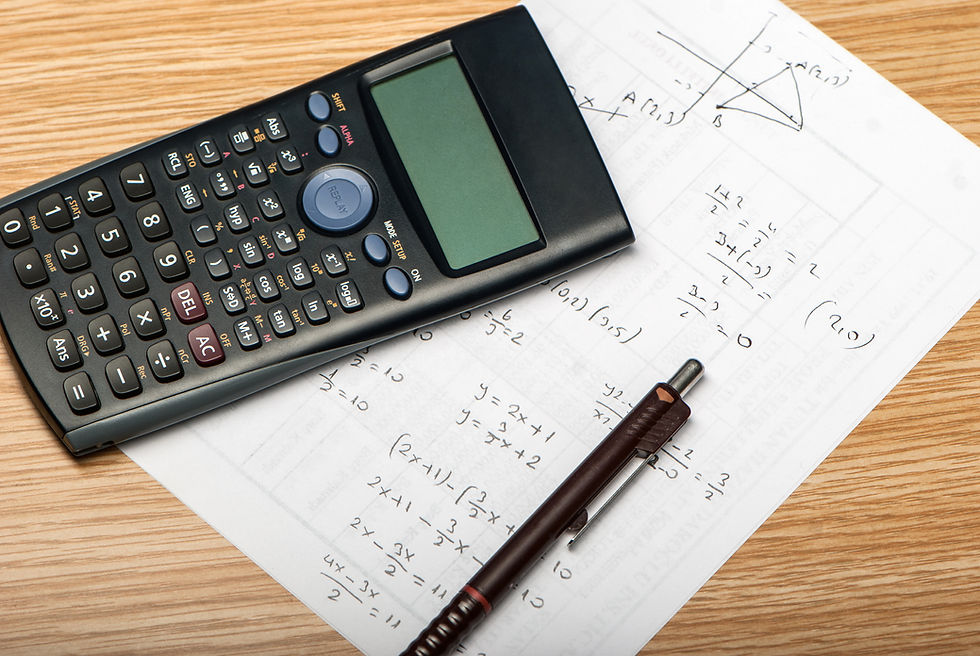
No. A calculator is useful where permitted and appropriate, but students still need strong number sense, algebra and estimation skills. Mental checks also help identify calculator-entry errors.
Why is Lower Secondary Math important for later E-Math and A-Math?
Many Upper Secondary topics depend on fluent algebra, manipulation, graphs and problem-solving habits developed in Sec 1 and Sec 2. Weak foundations can make later topics unnecessarily difficult.
What should students learn beyond getting the correct answer?
Students should learn to choose an appropriate method, show clear working, check for careless errors and explain mathematical reasoning where required. These habits become increasingly important in Upper Secondary Mathematics.
Are worksheets and worked solutions provided?
Yes, our curriculum-aligned Mathematics material includes notes, worksheets and worked solutions as part of its learning resources.
Can a student join in Sec 2 even if Sec 1 foundations are weak?
Yes, subject to availability. The student should identify the specific prerequisite gaps so that revision can be targeted while keeping pace with current Sec 2 work. Students can also join both the Sec 1 and Sec 2 classes at the same time.
Why do Sec 1 students sometimes struggle with Mathematics after primary school?
Secondary Mathematics introduces more algebraic thinking, abstraction and multi-step reasoning. Students who relied heavily on familiar primary-school methods may need time to adjust to symbolic working and new representations.
How can a student become less dependent on worked examples?
After studying an example, close the solution and solve a similar problem independently. Then explain why each step works and practise a variation where the method is not stated. This builds method selection rather than imitation.
How can parents tell whether a Math mistake is conceptual or careless?
Ask the student to explain the method without looking at the solution. If they cannot explain why the method works, the gap is probably conceptual. If the method is sound but execution repeatedly fails, the student should analyse the specific error pattern.
